

Last summer, my son, husband, and I had an evening routine. Creators Ryan Trahan and his wife, Haley Pham, were visiting fifty states in fifty days for St. Jude, and each day, a new YouTube video would drop. Most nights we’d watch. It was about travel, silly challenges, and kindness. And it was our family time.
So one afternoon at work, while testing Meta AI, I typed in Ryan’s name. It told me he lived in Texas, broad strokes about his life and career. It said nothing about the fifty states, the charity, or the new video waiting from the night before.
People don’t usually come to a social platform for a biography. If they wanted the encyclopedia version, they’d go to sites like Wikipedia or just Google it. They come for what’s happening now. Meta AI was answering a question no one was asking.
That instinct turned out to be much more than just a gut check. I dug in, and found supplemental insights that corroborated exactly what my product sense was telling me: timely information about famous people is a core reason people reach for social media products.
Now I had a real, validated insight. The question was how to change the product to address this need.
A Product Manager (PM) explained that the fix belonged at the orchestration layer, the layer that decides what the system does, not what it knows. We didn’t need to retrain the model. It already knew who this person was. It just needed to be told when to go look for what was new.
That was the day I stopped thinking about AI as a mystery, and started learning how it worked and what each layer was responsible for.
You can’t influence what you don’t understand.
As User Researchers, we have always been invested in deeply understanding our users to build great experiences, and it’s become commonplace to invest similarly in understanding our stakeholders to improve how we work together. Many of us carve out time to understand the business and market to improve how our insights land and where we need to win. But there’s one area we tend to pay less attention to: understanding the technology behind the products we support.
Understanding the tech we serve is what moves our insights from “interesting” to acted on. My finding was valid, but it went nowhere until I learned which part of the system it belonged to. What turned it into action was knowing enough about the tech to see which team could fix it, and what shape the recommendation needed to take.
AI is everywhere in the conversation, but how it actually works rarely is, and it’s easy to let “everyone’s talking about it” stand in for “I understand it.” That gap is more expensive than ever, because the pool of people who can actually change the product is growing. It used to be the engineer who shipped the change or the PM who called the shots. Now it’s whoever is willing to own the outcome: a marketer, customer support rep, or you. AI is democratizing how we get things done. So learning it isn’t just good practice, it’s how we keep up with a shift that’s here and still unfolding.
Let’s take that mystery apart. Underneath, the whole AI system is really three layers: the model, the orchestration layer, and the product experience.
Every AI system has a player, a coach, and a game.
The World Cup has been on for weeks, so I’ve been thinking in soccer metaphors (or football, for those outside the US) more than usual. Here’s one that actually stuck. The foundation model (or just “the model”) is like the player. It knows the plays, the moves, and when to score or fall back on defense. The orchestration layer is like the coach. They decide which play to run and when, whether to speed things up or run the clock out, and who plays which position. The game itself is the product experience. It’s what you see, hear, and feel. It shapes whether you have a good or bad time, whether you feel connected to other fans or alone, and whether you want to come back for another game.
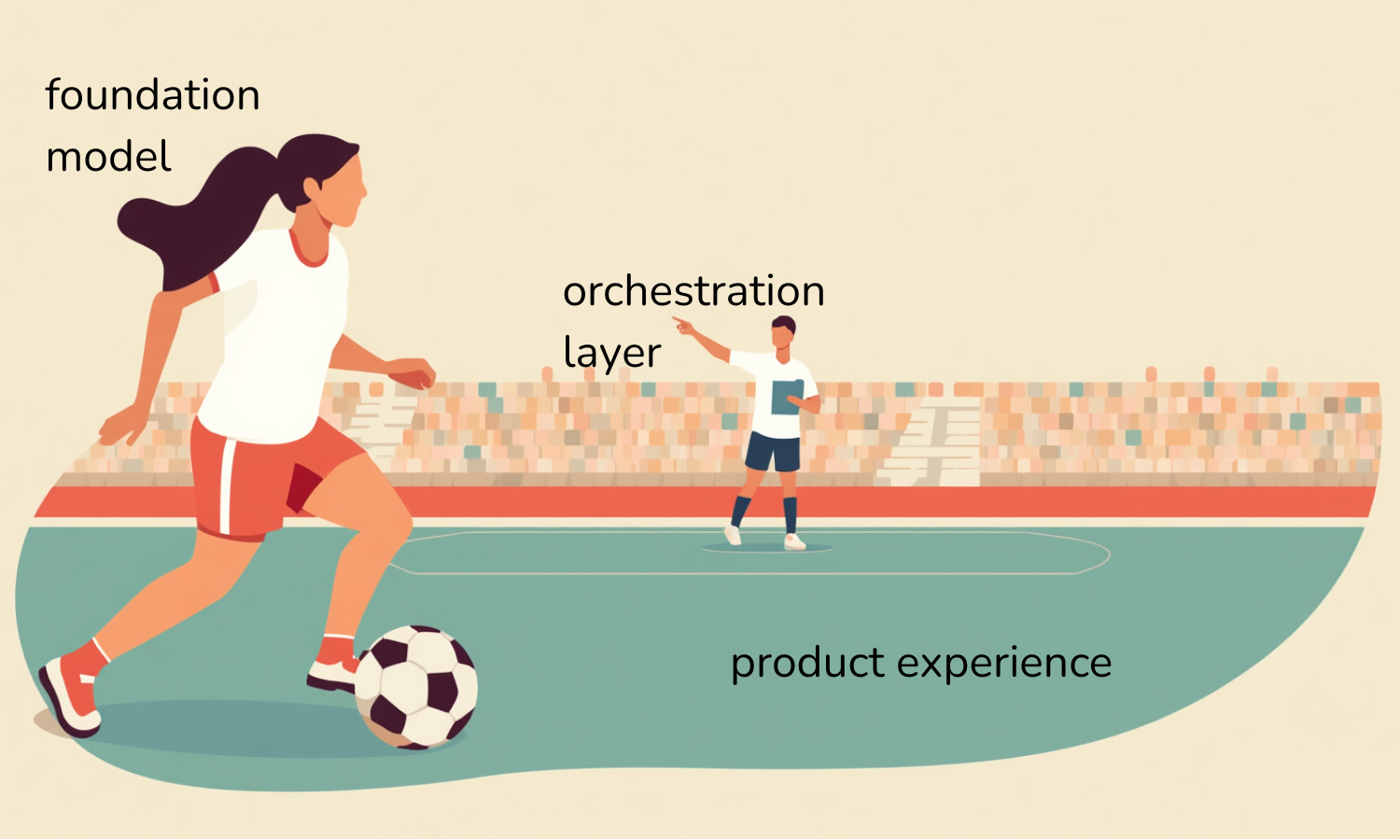
Each layer is a different place to make a change. Let’s start with the player.
The model is the layer that knows things. It knows every play it was taught, but not one that came after. It knew Ryan lived in Texas. It could never have known about the fifty states series, because that happened after its training ended.
There are many ways to influence what the model knows, from evaluating its responses to red-teaming its failures. One of the most overlooked is creating the data it is trained on. Models are trained on enormous amounts of data, and a lot of it has been scraped from the open web. But scraping is increasingly fraught, legally and ethically, which makes high-quality, consented data genuinely scarce. This is where researchers have an edge. Creating data legally, ethically, and with real consent is something we know how to do.
In one study, my colleague Patrick recorded users’ conversations with life advisors, with everyone’s permission, and turned the annotated transcripts into a “golden set” that taught the model more human ways to talk. Most product team members weren’t taught how to create data like that. User Researchers were trained for this.
Next is the coach. They handle what the player can’t.
The orchestration layer decides what the AI system should do right now. One of its most important calls is deciding what to do beyond generating a response, like calling a search plug-in that fetches what’s new. My problem needed a rule: when someone searches for a person, check whether something current is worth surfacing, and if so, go get it.
One team had already solved the problem, but only for themselves. They had written that trigger into their own app, so it worked there and nowhere else. That was the right instinct. They saw a problem in front of them and they fixed it. What none of us had realized was that every other app had exactly the same need. That’s what I learned: the fix didn’t belong to any single team. It belonged at the orchestration layer, one triggering policy applied everywhere, so the whole system knew to go look when a name came up.
This is the same layer where agents live. You’ve probably used an AI assistant, something that answers you when you ask it something. An agent goes further: it strings together a whole sequence of these decisions to get something done on your behalf. Same coach, calling a whole series of plays.
Last is the game. It’s where the model’s knowledge and the coach’s decisions become something the user can see, hear, and feel: the product experience. It’s the layer User Experience professionals know best, and it’s one ripe for improvement.
It’s easy for a team to focus only on the part of the experience they own. In my case, the tidy version went like this: someone opens the assistant on purpose, types a prompt, and reads the answer. But that was rarely how it went. Most people arrived from another app, Facebook, Instagram, WhatsApp, or their smart glasses, already in the middle of something. And once they had an answer, they were rarely done. They wanted to act on it: watch the video, join the group, leave a comment, send it to someone.
Let’s say the assistant finally tells me Ryan and Haley are visiting fifty states for St. Jude. Now what? Maybe I want to watch last night’s video. Or send the video to my son. Maybe I want to donate. If the experience dead-ends on the response, everything we fixed upstream was for nothing. Sometimes the answer is all someone needs. Often it’s the beginning of what they actually came to do. Understanding why people came to us and what they’re trying to accomplish lets us create a useful experience, and keeps us from shipping our org chart.
People shouldn’t have to learn the machine. That’s our job.
The bio data on Ryan was accurate, but it didn’t address my need. The model didn’t know that Ryan and Haley were visiting fifty states because it happened after training. The orchestration layer never went looking for something new. And even if it had, the product experience would have given me no way to act on it.
The next time you find a problem in an AI product, don’t sit on the insight because the AI is too opaque to touch. Ask which layers the solution touches and how they influence the experience. Seeing how the layers connect is what lets you solve for what someone actually came to do, not just the part your team owns.
And while today, we have three layers that make up an AI system, tomorrow there may be more. That’s fine, because the habit outlives the current system. The User Researcher who understands people, the business, the industry, and the machine is in a rare position. With AI democratizing who builds, this combination is what lets us create something people actually need instead of cool tech that nobody uses.
My son doesn’t need to know there’s an orchestration layer, and he probably doesn’t care. He just wants to know where Ryan and Haley are today. The people we build for never see the layers. Understanding them is our job.
If you want to see what we were watching each night, here is Ryan’s 50-states in 50-days.
With thanks to Patrick Doyle and Ben Lingard, whose feedback sharpened this piece.
Beth Lingard is co-authoring “Designing for Humans in the Age of AI” with Elissa Darnell . See you in a couple weeks.
love the soccer metaphors of player, coach and game!